
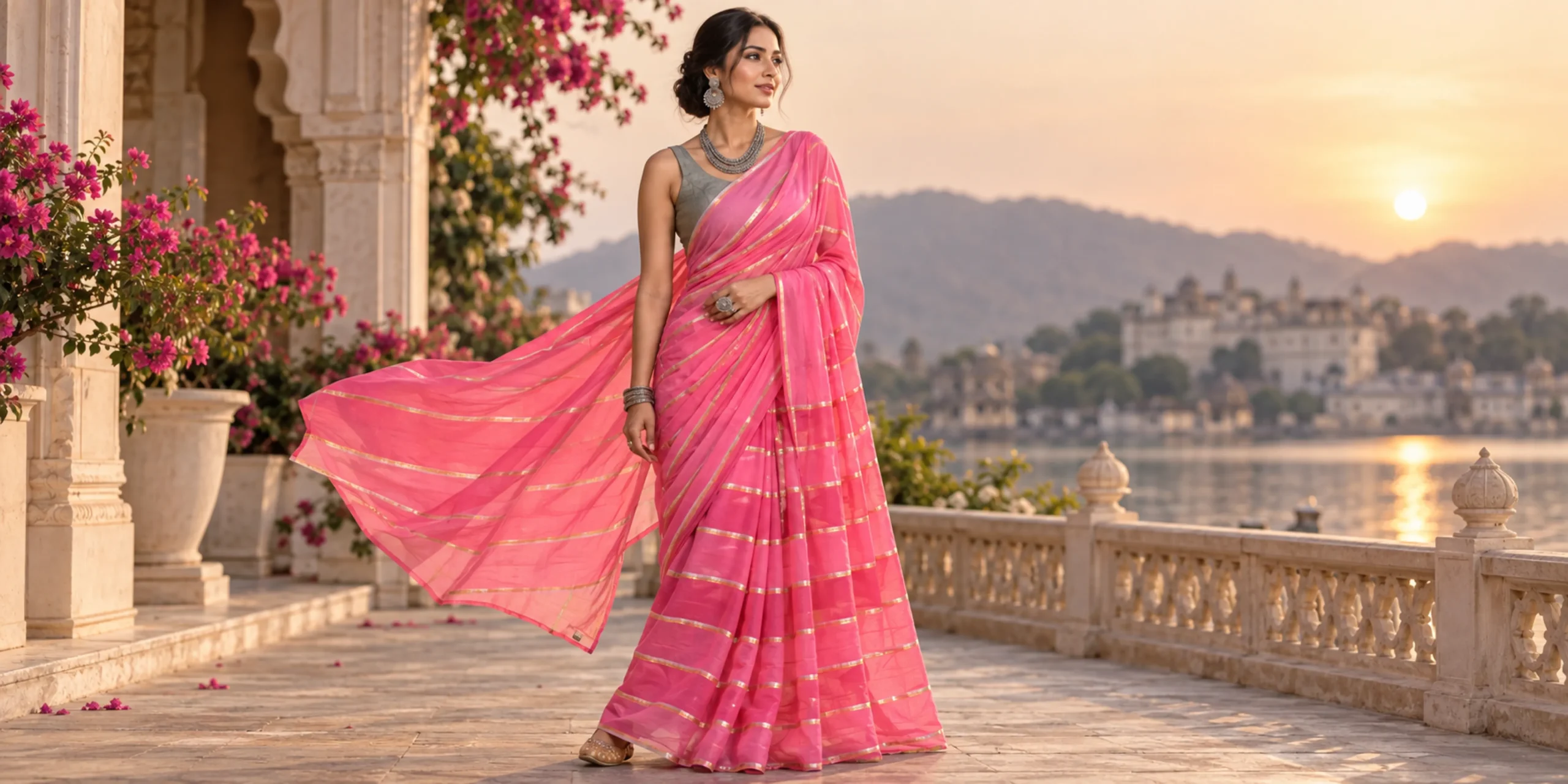
If you have ever worn a cotton saree through a Kerala afternoon and still felt the heat sitting on your skin, the fabric was probably not mul.
Mul cotton is cotton, but spun and woven differently — and the difference is one you feel within ten minutes of wearing it.
It starts with the yarn
All cotton begins as the same fibre. What separates one cotton from another is how finely that fibre is spun into yarn, and how closely the yarn is then woven.
Mul uses a finer yarn than everyday cotton. Finer yarn means more threads in the same width of cloth, and each one thinner. The result is a fabric that is lighter, softer and more open — air moves through it rather than sitting against you.
That openness is why mul is semi-sheer. It is not a flaw or a shortcut. It is the reason the cloth breathes.
Why it drapes differently
Pick up a mul saree and it falls. Pick up a heavier cotton and it holds its shape.
Finer yarn has less body, so mul folds in soft curves instead of standing in crisp pleats. If you want a saree that holds a sharp pleat all day, mul is the wrong choice and a south cotton is the right one. If you want cloth that moves with you and does not feel like armour by two in the afternoon, mul is what you are looking for.
This is also why mul suits long days. There is simply less fabric weight to carry.
Counts, briefly
You will see mul sold as 80 count, 100 count, 120 count, sometimes 140.
The number refers to the fineness of the yarn. Higher count means finer yarn, which means lighter, softer, more translucent cloth. A 120-count mul is noticeably finer than an 80.
Higher is not automatically better. A finer count is cooler and more elegant but also more delicate and more sheer. An 80 or 100 count will take more washing and more wearing. Most people find 100 to 120 the comfortable middle.
What to wear under it
Because mul is semi-sheer by design, wear a cotton slip or petticoat in a shade close to the saree. This is normal for the fabric and not something to work around.
A lighter slip under a light saree, a darker slip under a dark one. The sheerness then reads as softness rather than transparency.
Handloom means it will not be perfect
Our mul is handloom. A person sat at a loom and wove it.
That means you may find a slightly uneven thread, a small variation in the weave, or a border that is a fraction different along its length. These are not defects. They are the evidence that the cloth was made by hand rather than pressed out by a machine, and no two pieces are quite identical because of it.
Powerloom cotton is perfectly even. It is also flatter, and it does not soften the way handloom does.
How to look after it
Mul is finer than everyday cotton, so it asks for a little more care — but not much.
Hand wash separately in cold water, especially the first time, as colour may bleed. Do not wring it. Dry in shade rather than direct sun, which fades the colour and weakens the fibre. Iron on reverse while slightly damp.
Mul gets softer with every wash. A saree you have worn twenty times will feel better than the day it arrived.
When to wear it
Mul is the saree for an ordinary day. Teaching, travelling, a long working Tuesday, a warm afternoon with nothing particular happening.
It is not a wedding saree, and trying to make it one misses what the fabric is for. For a function, a Kanchi cotton with a woven border carries more weight. For the other three hundred days, mul is the one you will reach for without thinking.
Browse our mul cotton sarees →